Best AI Receptionist Software: A Realistic Comparison for Clinics in 2026

AI receptionists enable clinicians and healthcare providers to reclaim lost revenue due to missed patient calls. Choose from the carefully curated list of best AI receptionist software that never misses a patient call, books appointments, and follows up automatically.
What is AI Receptionist software?
An AI receptionist software may be defined as the voice or chat based system that answers incoming patient calls, comprehends the caller’s needs, and takes appropriate action. The AI receptionist may either book an appointment or verify insurance, or transfer the call to the staff, based on the understanding it derives while attending the patient call.
The best AI receptionist software provides advanced features like direct integration with scheduling systems, PMS, or EHR. This way a booked appointment is synced automatically to existing systems rather than requiring manual re-entry later.
TL;DR
Want to know the verdict, now? Here is a quick glance at the best AI receptionist software for clinics
Best AI Receptionist Software: Comparison Table
Tool | Built For | Notable Strength | Watch For |
Triagist AI | Clinics with diverse, multilingual patient bases | 100+ languages with automatic detection; bundles booking, WhatsApp/SMS follow-up, and patient recall in one platform | Newer platform; confirm current BAA/HIPAA certification directly |
Allo | Small, mobile-first teams | Affordable full phone system with AI receptionist built in; HIPAA-compliant tier available | Lighter on complex, multi-step scheduling workflows |
Smith.ai | Practices wanting a human safety net | Hybrid AI-plus-human model with warm transfer and full call context | AI Receptionist tier alone isn't fully HIPAA-compliant; premium pricing |
Synthflow | Larger or multi-location clinics | Enterprise-grade voice AI, highly configurable | Requires more setup investment and technical resourcing |
CallBird | US dental practices | Native Dentrix/Eaglesoft integration, focused no-show reduction tooling | Dental-specific; less relevant outside dentistry |
Patientdesk.ai | Dental practices wanting revenue automation | Insurance verification and payment collection during the same call, plus outbound lead follow-up; Y Combinator-backed | Built specifically around dental PMS workflows, not general medical clinics |
Prosper AI | Outpatient groups and health systems | Handles both patient and payor calls (benefits verification, prior auth, claims follow-up) across 80+ EHR integrations | Enterprise-oriented; likely overbuilt and costly for a single small clinic |
heyAnaya.ai | Dubai/UAE clinics and service businesses | Flat AED 1,000/month, Arabic-English voice, WhatsApp-native, 7-day setup | Regional focus (UAE); not built for US HIPAA workflows |
Picture this: Quarterly review meeting at a clinic. Someone brings up missed patient calls, while someone brings up high attrition rates in the front desk team. Why do we miss patient calls, and what each missed call costs us? This seems to be the primary focus of most of our quarterly review meetings.
A study of 7,000 calls across 22 medical practices found that 42% of incoming calls go unanswered, mainly because front desk staff cannot physically answer all the calls.
Summary of the discussion around missed patient calls:
Loss of revenue- Each missed appointment approximately costs $200 for a medical practice
Staff burnout and attrition- The best people leave because the call volume unsustainable (especially during peak hours)
Compounding inefficiency- Unanswered calls end up as voice mails that need call backs. When the call back happens, it is likely that it ends up in the patient’s voice mail, creating “round robin phone tag” that takes a long time to get resolved.
Patient dissatisfaction- Most of the patients whose calls are missed, don’t call back. Instead they go somewhere else.
Long story short, missed patient calls bleed our practice’s revenue. Our review discussions often navigate to "should we switch to AI receptionist software?". Our admin team is now seriously considering AI front desk software for clinics. How did we go about the evaluation? We are sharing details of the best AI receptionist software that we evaluated including our evaluation criteria and use cases for each of the tools we evaluated.
How we Evaluated these Tools
Investing in an AI receptionist software is both a financial and operational decision. So, we focused more on features that matter to clinicians and physicians, rather than marketing claims. The important evaluation factors include: call handling and language, scheduling depth, HIPAA and compliance posture, and human escalation. Here are some of the questions you need to be asking before choosing an AI receptionist software:
Does the tool handle natural language and topic changes mid-call?
Call handling quality and language support are amongst the top features to be considered.
What is the scheduling depth that the tool offers?
The tool must be able to handle new bookings, reschedules, waitlist backfill, and cancellations.
Does the AI Receptionist Platforms Ensure HIPAA Compliance and Data Security?
HIPAA compliance and BAA availability are critical for AI receptionist software
What is the implementation timeline for the tool?
The time from signed contract to going live must be short and require minimal training
How does the tool affect operational metrics?
Key operational metrics like no-show reduction, call resolution rate, and cost-revenue impact need to be evaluated before making the decision
What capabilities should medical AI receptionist software have?
We have shared the general evaluation criteria for choosing the best AI receptionist for healthcare in the previous section. But what are the must have capabilities of a medical AI receptionist software? While evaluating AI receptionist software for clinics, practice decision makers must ensure that the following operational standards are met.
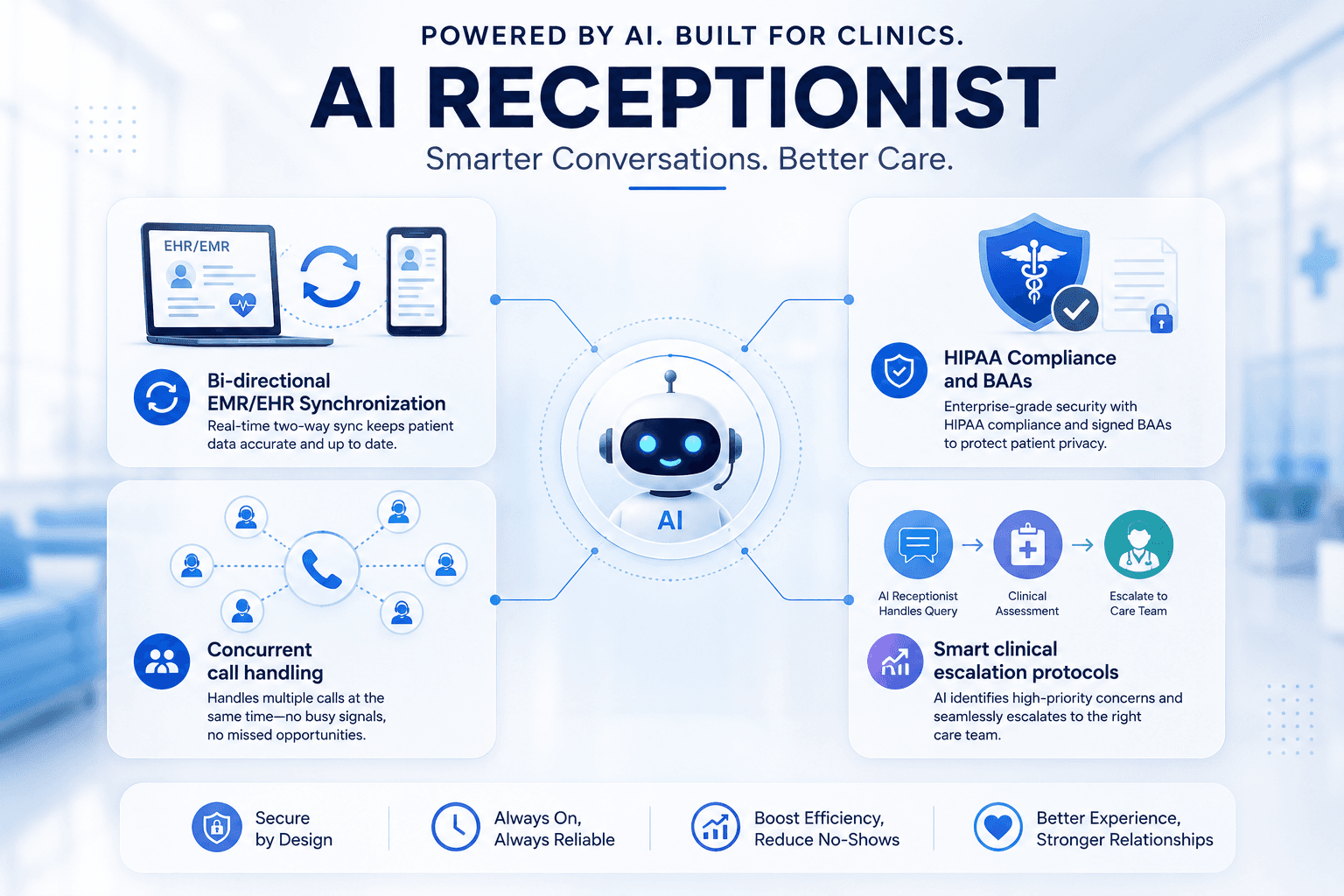
Bi-directional EMR/EHR Synchronization - An AI medical receptionist must have capabilities beyond taking messages or logging notes. Bi-directional integration capabilities to read real-time provider schedules, enforce complex appointment rules, and recording directly into your EMR, are a must for the AI receptionist software.
HIPAA Compliance and BAAs- Phone interactions at clinics involve Protected Health Information (PHI), which is why you need compliance beyond what basic commercial call-answering software offers. Ensure that the vendor signs a formal Business Associate Agreement (BAA) and encrypts audio recordings end-to-end and maintains strict access controls.
Concurrent call handling- The main drawback of the human front desk is the inability to handle more than one call at a time. The AI front desk software must cover up for this drawback and offer unlimited concurrent call handling capabilities to the tune of handling 50 callers simultaneously.
Smart clinical escalation protocols- The AI receptionist tool must route clinical (medical) questions or medical emergencies to clinical staff. The tool must offer customizable guard rails that can detect urgent medical conditions/symptoms and immediately transfer the call to on-call medical staff with full-context.
Top 8 AI Receptionist Software for Healthcare
In this section we will do a deep dive into the top HIPAA-compliant AI phone systems that are shaping the market. We will be looking into what each tool is actually built for, who it fits best, what sets it apart, and what it costs, so you can shortlist without booking eight separate demo calls.
Triagist AI
Purpose: Triagist AI is a broader clinical automation platform where the AI Receptionist is one module alongside an AI medical scribe, a patient growth engine, and an AI-native EMR. This is a relatively new entrant into the market that provides a meaningful and powerful combination of AI medical scribing, Front Desk automation and AI growth engine. The receptionist component answers calls in over 100 languages, books and reschedules appointments, and sends WhatsApp, SMS, and email follow-ups.
Best use cases:
Clinics with a multilingual patient base needing voice support beyond English
Practices wanting call answering bundled with recall, reminders, and retention campaigns rather than buying separate point solutions
Clinics also exploring AI clinical documentation, since the scribe and receptionist share the same platform and patient record
Key differentiators:
100+ languages with automatic detection mid-call
Bundles receptionist, scribe, growth engine, and EMR under one data layer
States HIPAA, GDPR, and DPDP readiness, with end-to-end encryption and audit logging
Pricing: Structured as credit-based platform tiers, Essential (500 credits/month), AI Pro (1,000 credits/month, includes the AI-native EMR and medical scribe), and Enterprise (unlimited credits, custom terms). The AI Receptionist is available as an add-on module on top of a base plan. Exact dollar pricing isn't published as a static rate card, so confirm current numbers through a free trial or a sales conversation.
Allo
Purpose: Allo is a mobile-first business phone system with an AI receptionist built into every paid plan, positioned for small teams that want one bill covering calls, texts, and AI answering rather than assembling a separate phone system and AI add-on.
Best use cases:
Solo practitioners or small clinics that want a full phone system, not just an AI layer bolted onto an existing line
Teams that move between rooms or locations and need a mobile-first app rather than desk hardware
Practices prioritizing flat, predictable pricing over usage-based billing
Key differentiators:
AI receptionist, call transcription, and AI summaries included on every paid plan at no extra cost
No per-minute billing on domestic calls, unlike most competitors in this comparison
CRM sync built in (HubSpot, Salesforce, Attio, and others) without middleware
Pricing: Starter at 18/user/monthbilledannually(25/month billed monthly), Business at 32/user/monthbilledannually(45/month), and Ultra at 100/user/monthbilledannually(120/month). No setup fees, no long-term contract, and a 7-day free trial.
Smith.ai
Purpose: Smith.ai runs two distinct product lines: a pure AI Receptionist tier for routine call answering, and a hybrid Virtual Receptionist tier where trained human agents handle calls with AI support. The hybrid model is the differentiator, live humans as a genuine fallback for sensitive or complex conversations.
Best use cases:
Practices that want a human safety net for emotionally sensitive or high-stakes calls
Clinics willing to pay a premium for a live-agent experience over pure automation
Teams testing AI call handling first before committing to the higher-cost hybrid tier
Key differentiators:
Warm transfer to a live human agent with full call context, not a cold handoff
30-day money-back guarantee on the Virtual Receptionist tier, capped at $1,000
Established track record, founded in 2015, with a large verified review base
Pricing: The AI Receptionist tier starts free for 25 calls/month The Pro tier starts at $150 per month for 75+ calls per month, and the Enterprise tier is priced at $500 per month for 300+ calls per month.
Synthflow
Purpose: Synthflow is a no-code, drag-and-drop platform for building custom voice AI agents. It's less a packaged "receptionist product" and more a configurable voice AI engine that a clinic (or its IT partner) assembles into a receptionist workflow.
Best use cases:
Larger or multi-location clinics with the technical resourcing to configure a custom voice flow
Organizations wanting deep control over call logic, integrations, and voice quality rather than a fixed feature set
Teams already evaluating enterprise voice AI platforms and comparing per-minute economics directly
Key differentiators:
High configurability and strong voice quality, built on ElevenLabs text-to-speech
No-code flow builder, so no developer is required to launch a basic agent
Positioned as voice-only; no native WhatsApp or web chat channel bundled in
Pricing: Synthflow restructured its pricing in 2026 and retired its legacy Starter/Pro/Growth/Agency tiers. It now offers a Pay-As-You-Go plan with usage-based rates that typically land between $0.11 and $0.24 effective per minute depending on configuration, and an Enterprise tier for high-volume deployments starting at $30,000/year.
CallBird
Purpose: CallBird is a dental-first AI receptionist focused specifically on capturing missed calls and reducing no-shows through native PMS integration and automated reminder sequences.
Best use cases:
Single-location or small multi-location US dental practices
Practices whose primary pain point is no-shows rather than broader revenue-cycle automation
Clinics wanting fast, low-friction setup with transparent, published pricing
Key differentiators:
Native, read-write integration with Dentrix, Eaglesoft, and Open Dental
Case data showing no-show rates dropping from an 18–25% baseline to 4–8% with automated reminder sequences
Transparent tiered pricing published on the website, unlike several competitors that require a sales call
Pricing: Starts at $99/month with no setup fee, covering solo operators and small teams. The Pro plan is priced at $249 ideal for growing businesses. And the Enterprise plan is priced at $499 per month suitable for high-volume and multi-location operations.
Patientdesk.ai
Purpose: Patientdesk.ai is a Y Combinator-backed platform built specifically for dental practices, going beyond call answering into real-time insurance verification and payment collection during the same call, plus outbound follow-up for unbooked leads.
Best use cases:
Dental practices where insurance verification and collections consume significant front-desk time
Practices running paid lead generation that want automated, immediate follow-up on inbound leads
Clinics wanting one system that handles booking, insurance eligibility, and billing reminders together rather than three separate tools
Key differentiators:
Verifies insurance eligibility and collects member/coverage details live during the booking call, rather than as a separate follow-up step
Automatically identifies patients with outstanding balances and calls them proactively
Native integrations across Dentrix, Open Dental, Eaglesoft, CorePractice, and other dental PMS platforms
Pricing: Not publicly listed. Patientdesk.ai sells through a demo call and custom quote, reflecting the bundled scope (booking, verification, collections, and lead follow-up) rather than a flat per-seat rate. Ask specifically how pricing scales with call and lead volume before committing.
Prosper AI
Purpose: Prosper AI is an enterprise-grade voice AI platform built for outpatient groups and health systems, and it's the only tool in this comparison that automates both sides of the phone, patient-facing calls (scheduling, refills, billing questions) and payor-facing calls (benefits verification, prior authorization, claims follow-up).
Best use cases:
Multi-provider outpatient groups or health systems with high call volume across both patients and insurers
Organizations whose bottleneck includes staff time spent on hold with payors, not just patient call answering
Teams that need broad EHR compatibility across a large, complex tech stack
Key differentiators:
Handles payor-side calls directly, navigating IVR trees and holding for a live rep when needed, a capability none of the other seven tools here offer
80+ EHR integrations and reported deployment across 150,000+ providers
Vendor-reported figures include 50%+ operational cost reduction, 20%+ revenue increase, and 99%+ QA call accuracy, with typical go-live in about three weeks
Pricing: Not publicly listed. Prosper AI sells enterprise contracts with custom, volume-based pricing, standard for platforms built around health systems rather than single-location practices. Expect a sales-led process rather than a self-serve signup.
heyAnaya.ai
Purpose: heyAnaya.ai is a regional AI receptionist built for the Dubai/UAE market, serving clinics alongside other appointment-based service businesses (salons, gyms, home services) with bilingual Arabic-English voice support and WhatsApp-native communication.
Best use cases:
Clinics operating specifically in the UAE or wider Gulf region needing Arabic-English call handling
Practices already communicating with patients primarily through WhatsApp
Smaller practices wanting a flat, low-cost monthly rate without US-style per-call or per-minute billing
Key differentiators:
Bilingual Arabic-English voice support built for the regional market, not a bolted-on translation layer
WhatsApp-native follow-up, matching how patients in the region typically communicate
Fast deployment, live in about 7 days, with a 14-day free pilot
Pricing: Flat AED 1,000/month (roughly $270 USD), month-to-month with no long-term contract. This is meaningfully cheaper than a human receptionist in the same market (roughly AED 6,500/month), but it's built around UAE business norms rather than US HIPAA workflows, so US-based clinics should look elsewhere on this list.
Where Triagist AI Fits Among Recognized Platforms
Different clinics compare different tools together, depending on what they're actually solving for. Here's where Triagist AI shows up in those conversations, and where it doesn't.
Multilingual patient communication: Clinics with non-English-speaking patient populations typically shortlist Triagist AI alongside Synthflow and PolyAI, since voice-native multilingual handling, not translated text bolted onto an English-first model, is what these three compete on.
Small to mid-sized practice budgets: For clinics prioritizing flat, predictable cost over enterprise contracts, Triagist AI tends to get compared with Allo, Rosie, and Goodcall, tools built around accessible entry pricing rather than custom sales-led quotes.
Bundled patient engagement, not just call answering: Clinics wanting call handling paired with reminders, recall, and retention automation in one system often weigh Triagist AI against Weave and Solutionreach, platforms that similarly treat the receptionist as one module inside a broader patient communication suite.
Dental-specific PMS workflows: When the priority is native Dentrix or Eaglesoft depth specifically, Triagist AI appears in the conversation alongside CallBird, Patientdesk.ai, and Arini, though it's fair to note Triagist's dental integration is less specialized than these dental-first tools built around that single workflow.
The Next Steps
Each medical practice has unique financial and operational requirements, which influence the choice of AI receptionist software. The background when we were evaluating the best AI receptionist software was to recover the lost revenue due to missed patient calls and to reduce the front desk staff burnout. What is yours?
Choose the best AI receptionist for healthcare that aligns with your operational needs and fits into your budget. If you are looking to automate both front-office call intake and physician documentation within a single system, Triagist AI is your go to platform. Sign up for the free trial to see how.
