AI Receptionist for Clinics: The Complete Guide to Never Missing Another Patient Call

Managing a medical or healthcare practice requires juggling of calls, appointment schedules, and urgent requests. Doing all this manually will lead to missed opportunities. An AI receptionist for clinics ensures your front desk runs smoothly and all patient interactions are handled professionally and compassionately.
What is an AI Receptionist for Clinics?
An AI receptionist for clinics is an intelligent, voice-automation tool that handles inbound patient calls, schedules appointment calls, and follows up automatically. An AI voice receptionist is equipped to handle inbound and outbound phone interactions for medical and healthcare practices. Modern virtual receptionist for clinics use natural language processing (NLP) to converse naturally with patients.
TL;DR
The unseen costs of an empty (unavailable) front desk can spiral into serious finance and operational implications that could cost your practice dearly.
Data has shown that missed appointments cost the US healthcare industry a whopping $150 billion annually.
What does the front desk burn out actually cost your practice? You bleed revenue through missed calls, scheduling gaps, and patient churn that compounds over months before anyone can connect it to an inefficient or an overwhelmed front desk.
Front desk burnout is not a soft HR problem, it is a financial and operational crisis that is hiding in plain sight. Every manual, repetitive task that you automate is one step closer to building a highly efficient and available front desk.
AI receptionist for clinics combine natural language processing, voice recognition, and healthcare-specific integrations, to reshape how clinics manage patient communication and engagement.
Your front desk staff play an important part in boosting the care experience for every patient. Patients who have a positive experience during the initial stages are likely to return and recommend your clinic to others. But, is your front desk up to handling an average of 53 calls per day per physician? With the industry missed call rates of 30-35% during peak hours, there is clearly an operational gap.
Every single one of those missed patient calls was a patient in pain, a worried patient or a new consultation that simply slipped through an overburdened front desk. Front desks at clinics and healthcare providers’ operate manually, which increases the chances of missed patient calls and a dip in the quality of patient engagement.
State of Medical Front Desk Operations at a glance….
An average healthcare clinic misses 30-35% of its inbound patient calls.
The average hold time is more than 8 minutes, which translates to 1 in 3 callers hanging up before reaching a staff member.
Bureau of Labor Statistics (2024 report) reports that costs for front desk staff have risen by 21% since 2020, and many clinics have found it challenge to retain skilled staff members
Accenture Reports that 76% of patients prefer digital channels for communication (including texts, SMS, web chats) to telephonic communication.
The need to digitize patient communication channels is direr than ever before. In this blog we will explore the need for an AI front desk, what an AI receptionist is, and how an AI receptionist for clinics reduces missed patient calls and improves patient engagement.
Why Does your Front Desk Need Automation Now?
We have seen some compelling statistics on the financial and operational consequences of missed patient calls. The following points strengthen the case for appointment scheduling automation and AI patient communication.
Missed patient calls = lost revenue
Every unanswered patient call represents lost practice revenue and a frustrated patient. During peak hours the hold time of patient calls is also more, which adds to the frustration. Also, front desk staff is often overwhelmed with massive call volumes, which in turn affects their efficiency and leads to burn out.
Front desk staff burnout = Compromised patient engagement
Clinic admin teams are often under the pressure of context switching between walk-in patients, insurance paperwork tasks, and answering new patient inquiries. Frustrated and overwhelmed front desk staff face mental fatigue and cognitive exhaustion.
Single channel Capacity=Long holdups
Human receptionists can only speak to one patient at a time, which creates long phone hold times during peak hours. Patients that are put on hold are most likely to cut the call and reach out to the competitor clinic.
High no show rates=Wasted Physician time
Manual appointment confirmations by the front desk staff are done via phone calls, where the likelihood of overlooks on the physician’s schedule is high. When the follow up is not done properly, patients don’t show up and the doctor’s time gets wasted.
AI Receptionist vs Virtual Receptionist- Key Differences
These two terms are often used interchangeably. However, there are some key differences that we will highlight here. A virtual receptionist for clinics may sometimes refer to a human receptionist working remotely attending calls. An AI receptionist on the other hand refers to a fully automated AI front desk that is essentially a software trained to work like a human receptionist.
It is important to understand the distinction between the two when comparing vendors, because pricing, scalability, and consistency vary depending on the model which you are buying. A virtual receptionist has all the strengths and limitations of a human receptionist. An AI receptionist scales instantly and never takes a break, but it needs clear rules for when to transfer the call to a real person.
How Does An AI Receptionist for Clinics Work?
The AI receptionist from Triagist AI never misses a single patient call, understands the patient’s need, and takes action instantly. The AI receptionist does everything that your front desk does; from answering calls to booking appointments to following up with patients. Basically, Triagist AI does all the heavy lifting in the admin work so you can focus on patient care. Here is how the AI receptionist works:
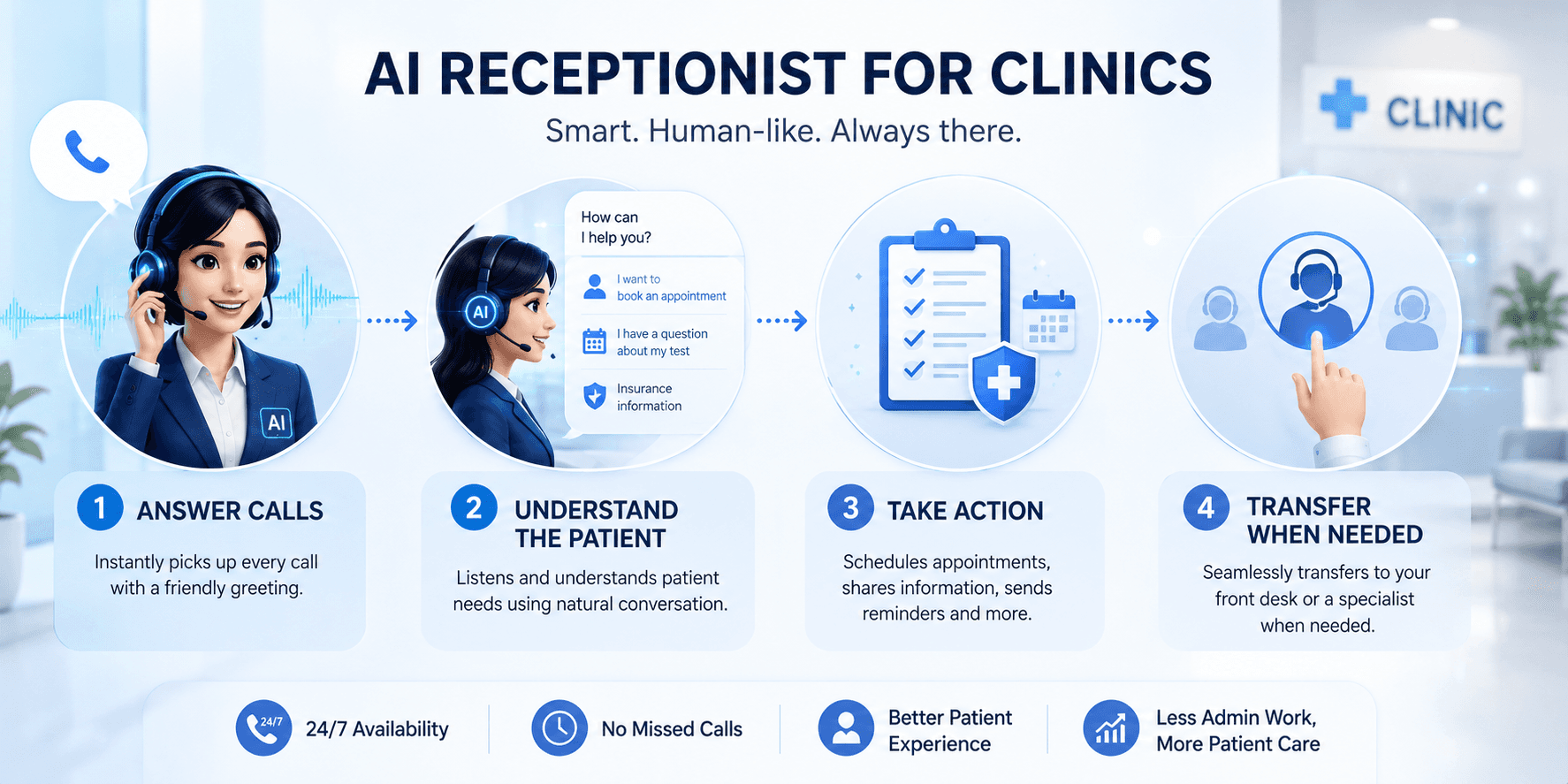
Answer calls: Not even one patient call is missed with an AI receptionist. Calls are answered instantly (no wait or hold time) with a natural, multi-lingual AI voice. Triagist AI supports 100+ languages in text and voice. No busy tones or missed calls or IVR menus.
Understand the patient: The AI receptionist is built on natural language processing. Triagist understands the patient's natural speech and deciphers their intent, answers common questions, and identifies their needs accurately.
Take action: After deriving context from patient calls, the AI voice receptionist takes appropriate action by either booking appointments, or rescheduling visits, or sending appointment confirmations on Whatsapp, or updating patient records, all this in the same call.
Transfer when needed: The AI receptionist transfers calls that need clinical judgement or human assistance. The call is transferred to the clinical team with the full conversation context.
Capabilities that AI Receptionist brings to the Front Desk
AI Appointment Management: AI appointment booking capabilities takes care of booking new appointments, rescheduling or cancelling visits, and sharing slot availability.
Follow-ups and Retention: Post-visit check-ins, recall of inactive patients, and medication and care reminders are automated by the AI front desk.
Patient support: The AI patient communication is maintained by the receptionist software. Patient FAQs are answered instantly, doctor availability and timings are communicated, and services, fees, and insurance details are communicated constantly.
24x7 Call Handling: No more patient missed calls with the AI receptionist, as it answers every call anytime. Captures after-hours enquiries and books appointments instantly.
How does an AI receptionist reduce missed calls?
No more missed patient calls with AI receptionist. All calls are instantly answered, even during lunch breaks, after hours, or whenever staff is occupied with patients. This way no call rolls into voicemail or goes unanswered.
We have discussed the hidden cost of missed patient calls in a couple of places in the above sections. A patient who can't get through rarely leaves a voicemail and waits. More often, they simply call the next clinic on their list, especially if they're dealing with pain or a time-sensitive issue.
Such situations occurring on a daily basis have major financial and operational impact on the practice. With an AI receptionist, there will be no missed calls or calls out on hold. Also, since the AI receptionist does not have shift hours, it closes the gap completely. Every call gets picked up, every caller gets a response, and the clinic stops losing patients to something as fixable as an unanswered phone.
AI Receptionist vs. Traditional Front Desk Software
Human Front Desk | AI Receptionist | |
Availability | Business hours only | 24/7 |
Cost structure | Salary plus benefits | Monthly subscription or per-call pricing |
Handling call spikes | Limited by staff on shift | Scales instantly, no wait time |
Complex or sensitive calls | Strong, handled with judgment | Needs clear escalation rules to a human |
Walk-in and in-person triage | Handled naturally | Not applicable |
Neither column wins outright. A clinic's front desk staff will always outperform AI on the in-person moments, comforting an anxious patient, reading a room, making a judgment call on an exception. What AI wins on is consistency and availability: it doesn't get overwhelmed at 8:45 on a Monday morning, and it doesn't clock out at 5.
Key Benefits of an AI Receptionist for Clinics
When the front desk operations are automated with an AI receptionist, all admin operations are streamlined for maximum efficiency. At the outset, AI receptionists reduce patient missed calls and the associated costs. Clinicians and doctors stand to gain the following advantages by using AI receptionists:
Fewer missed patient calls. No ring-and-drop during busy hours, all patient calls are answered instantly.
Faster appointment scheduling automation. AI appointment booking enables patients to book in real time instead of waiting on hold or for a callback.
Consistent AI patient communication. Reminders, confirmations, and follow-ups go out automatically, without relying on staff to remember.
Lower front-desk overhead. One AI front desk tool absorbs call spikes without the clinic needing to add headcount.
After-hours coverage. Patients can book appointments or get basic answers outside normal clinic hours.
Data and call insights. Transcripts and summaries give staff a quick way to review calls and spot recurring issues.
Specialized Use Cases: Matching AI Receptionists to Practice Needs
AI Receptionists for Small Practices
Small and solo practices often lack dedicated call-center staff. An AI call answering system acts as a virtual full-time employee at a fraction of the cost, ensuring every prospective patient inquiry is captured, qualified, and scheduled.
AI Receptionists for Dental Clinics
Dental practices experience high call volumes for emergency walk-ins, routine cleanings, and complex treatment inquiries. An AI receptionist for a dental clinic dynamically checks provider schedules, books emergency slots, and sends pre-procedure preparation guidelines instantly via SMS.
Multi-Specialty & Healthcare Call Center AI
For large clinics and health networks, voice AI scales across multiple departments, routing specialized inquiries, processing prescription refill requests, and managing automated patient communication campaigns at scale.
Choosing the Right AI Receptionist for Your Clinic
Choosing the right AI receptionist for clinics is a major investment decision that clinicians need to make. The important checkboxes that the AI receptionists have to tick off are listed below:
HIPAA compliance and data security are non-negotiable for any healthcare virtual assistant. Ask directly about certifications and where patient data is stored, don't assume compliance from a general-purpose voice AI vendor.
EHR or practice management system integration determines whether the AI can actually see and book real appointments, or whether it's just collecting information for staff to enter manually later.
Multilingual support matters if your patient base isn't entirely English-speaking, and it's worth testing directly rather than taking it on faith.
Depth of appointment scheduling automation is easy to overlook. Ask specifically whether the system handles rescheduling, cancellations, and waitlists, not just new bookings, since those make up a large share of real call volume.
Human escalation logic should be spelled out clearly. Ask what happens, step by step, when a caller describes urgent symptoms or asks for a human.
Pricing models varies widely, flat monthly fees, per-minute charges, and per-call pricing all show up in this space, and the right one depends on your call volume.
Voice AI and Future of AI Front Desk
Voice AI has reached a point where patients cannot tell at least in a few seconds of the call that they are speaking to software rather than a person. Adopting clinic phone automation does not remain a trend anymore, it is a competitive necessity for modern healthcare practices.
Healthcare AI receptionists like Triagist AI combine appointment scheduling automation with intelligent patient communication. Enabling practices to capture every lead, boost patient engagement, and give clinical admin staff their time back.
Ready to see how an AI front desk transforms patient intake and engagement?
Book a live demo of Triagist AI today.
