AI Medical Scribe vs. Human Scribe: Which Is Best for Your Practice?

Manual clinical documentation can be labor-intensive. Learn how AI Medical Scribe Software overcomes the challenges in manual scribing.
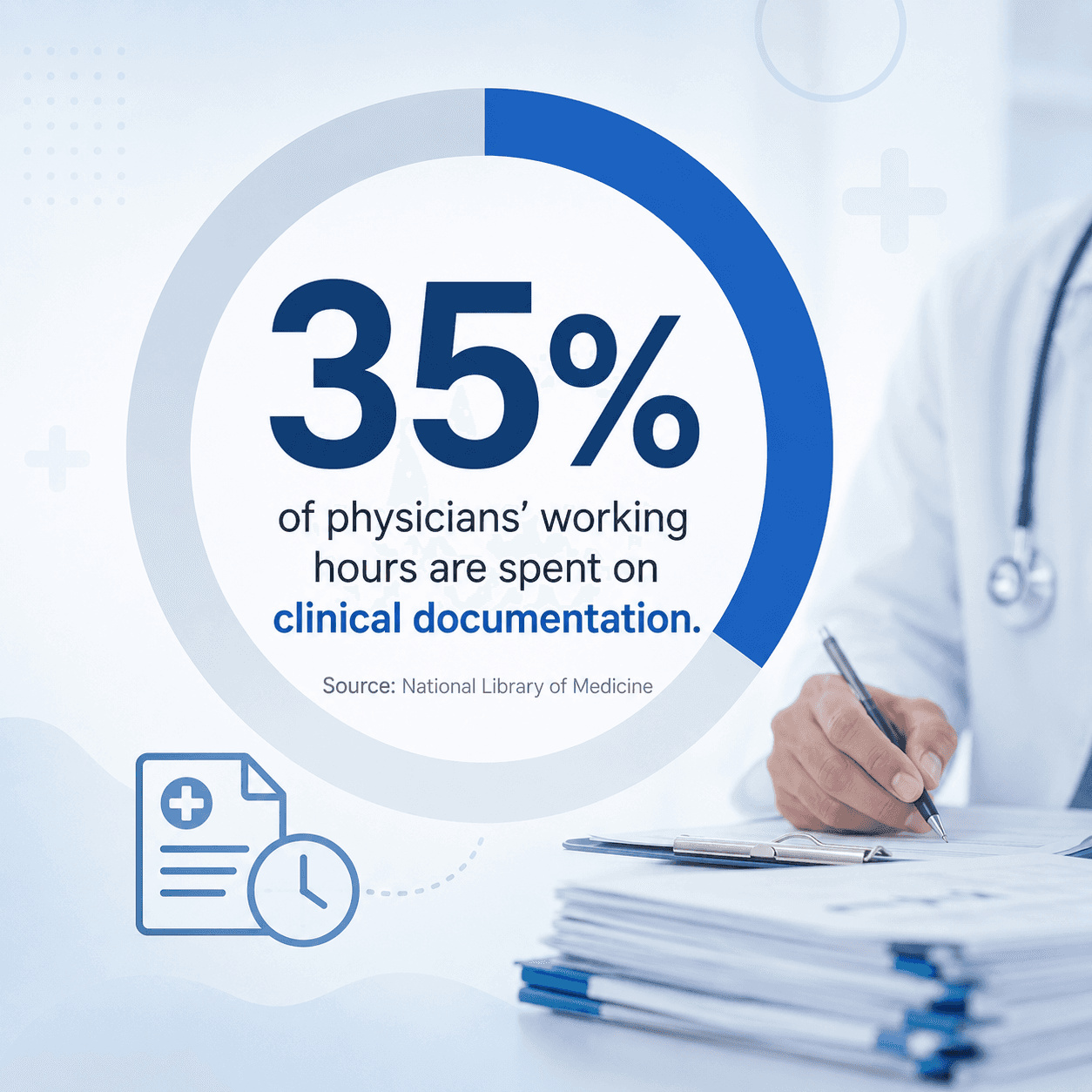
Physicians spend 35% of their working hours on clinical documentation, as per the National Library of Medicine. What if this time could be brought down by 2 hours (or more)? Physicians and healthcare professionals would get time to focus on people rather than mundane paperwork! AI Medical Scribe.
What is AI Medical Scribe?
An AI medical scribe is a digital tool that implements AI technology to record, transcribe, and summarize physician-patient interactions. AI medical documentation software or AI Clinical Documentation Software are other names by which an AI Medical Scribe goes by. A study on “AI Scribes in Healthcare: Balancing Transformative Potential with Responsible Integration” by JMIR Publications highlighted that ambient AI scribes offer potential solutions to a previously difficult-to-bridge technological gap in clinical documentation.
TL;DR
Healthcare professionals face increasing pressure to provide exceptional patient care while managing a growing volume of documentation.
For specialists caring for patients with serious or chronic illness, preparation cannot be just a quick scan of the patient chart. A patient's medical history (spanning months to years) acquired from multiple sources usually includes visit notes, lab results, reports from outside, and genetic test results.
Clinical documentation needs to be compiled and made available for physicians before the patient’s visit, so the conversation can begin with context rather than recounting medical history.
Manual clinical documentation can steal away a huge chunk of physician’s work time, leaving them with less time for patient care. This translates to compromised healthcare and ultimately hits the practice’s bottom line.
Smart preparation with the help of AI charting software before a patient visit gives physicians the context for consultation. An AI medical scribe helps them care more for their patients and less time on documentation.
Delivering quality healthcare is definitely top priority for healthcare providers and physicians. When a patient walks in for an appointment and the physician is well informed about the medical history, it elevates the quality of healthcare significantly. When manual clinical documentation methods are followed in clinics, a significant part of physician’s time is spent on gathering and collating patient’s information.
A Medscape annual Physician Burnout and Depression report reveals that in 2020 55% of physicians reported that bureaucratic tasks like medical charting and documentation were the #1 contributor to physician’s burnout. A report by National Library of Medicine reveals that bureaucratic admin work and clinical documentation is an important factor for physician burnout.
Manually composing SOAP notes requires accurate recording of the complete patient-physician conversation, translation of casual dialogue into accurate medical terminology, and building a narrative from scratch. This kind of cognitive load on healthcare providers is consistently linked with physician workout. Physicians today require more advanced solutions that are able to automate bureaucratic tasks that year after year plague them and contribute to their burnout and depression. As healthcare organizations continue to embrace digital transformation, AI medical documentation software is becoming an essential part of the modern medical practice.
This blog explores:
The Clinical Charting and EHR Overload Crisis
AI clinical documentation in detail
Ambient AI Scribe vs Human Scribe Vs Legacy Dictation
The AI Clinical Documentation Lifecycle with Triagist AI
Benefits of AI clinical documentation software
Crunching the Numbers - ROI and Cost Analysis
The Clinical Charting and EHR Overload Crisis
Ever since the introduction of electronic health records in 2010, physicians have been struggling to keep up with their documentation. Long after their grueling work shift, physicians sit down to a second full shift- the shift for documentation! Physicians open up their laptops to log hours into the electronic health record (EHR). This is the famous (or should we say infamous) pajama time- the exhausting, uncompensated late-night charting ritual that has distanced physicians from the human connect.
What was intended to be a tool to streamline care has now become a primary driver of clinical burnout. How?
Physicians spend 9 minutes charting for every 15 minutes of patient interaction
Up to 70% of EHR users experience health information technology related stress, which commonly results in 6 or more hours of charting per week outside of regular clinical hours
The staggering administrative burden contributes to the projected shortage of over 86,000 physicians by 2036
Up to 85% of physicians agree that documentation performed solely for billing purposes artificially inflates the total time required.
With doctors and clinicians burdened with bureaucratic tasks, it is natural that patient interaction takes a hit. Not to mention the clinician burnout and depression. AI clinical documentation software is a preferred solution that would reduce charting time significantly and improve accuracy of documentation.
Exploring AI Medical Scribe in Detail
We have briefly defined what an AI medical scribe is at the beginning of this blog. Let us explore Ambient AI medical scribe in greater detail. An ambient AI medical scribe may be thought of as an voice-to-note AI or a medical dictation AI technology that passively listens to natural patient-physician conversations, distinguishes between the speakers, and automatically generates structured clinical documentation(similar to SOAP notes). All this without the clinician having to type, click, or dictate.
AI note-taking for doctors provides much more value than a human scribe who writes down information verbatim. Ambient AI documentation filters out the noise (read small talk), extracts critical medical information, and automatically organizes it into relevant sections in the patient chart. Clinical note automation takes on the heavy lifting in clinical documentation, so you can focus on what matters most- patient care.
Core Capabilities of AI Medical Scribe
Ambient listening and natural language processing form the core of AI medical Scribes. AI documentation assistants combine ambient listening and natural language processing to passively record, transcribe, and summarize patient-clinician conversations. An AI medical scribe is also referred to as AI doctor notes software when it primarily converts spoken encounters into structured notes, or AI SOAP note software when it converts conversations into SOAP notes. AI note-taking for doctors is extremely convenient and provides a comprehensive account of the patient history and doctor’s medical advice.
Core Features Based on Functionality are:
1- Automated Transcription and Comprehension
Real-time speech recognition - Conversations are instantly converted into raw text by eliminating the noise and irrelevant conversations.
Speaker attribution - Voice-to-note AI is able to clearly distinguish various individuals in the room, including, doctor, patient, and other members.
Medical knowledgebase- Ambient AI documentation software is equipped with advanced medical dictionaries that help them recognize specialty terms, drug names, acronyms, and treatments.
2- Workflow and System Integration
EHR interoperability - Integrates bidirectionally with major Electronic health record systems to pull patient histories and feed finalized SOAP notes directly into the chart.
Contextual Awareness - Reviews patient past charts automatically before the consultation to provide the AI engine with the medical context
Coding intelligence - Automatically extracts diagnosis and procedure details to provide appropriate suggestions on ICD-10, HCC, and CPT codes, which improves billing accuracy
3- Clinical Note Generation
Template customization - Allows clinicians to enforce their preferred writing styles, unique section structures, and abbreviations
Structured output mapping - Organizes transcribed dialogue into standard medical documentation formats like SOAP or DAP notes.
Multi-lingual support - Patient interactions are readily translated and documented in real time in different languages.
4- Privacy and compliance
HIPAA and SOC 2 Compliance - Ensures stringent security and encryption protocols are followed during data capture and processing
PII Redaction and Data Deletion - Personally Identifiable Information is intelligently masked and unnecessary information is removed automatically
The AI Clinical Documentation Lifecycle with Triagist AI
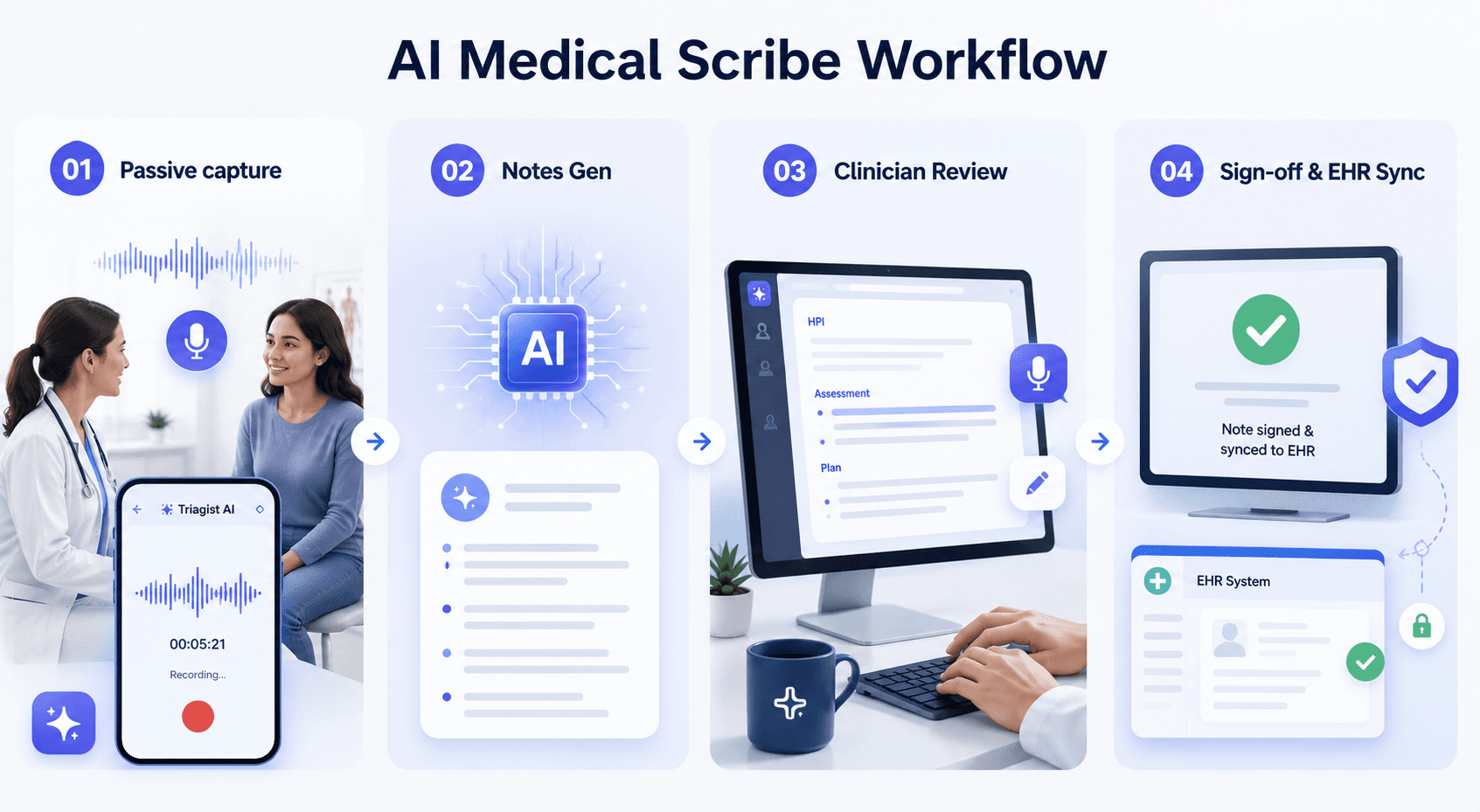
The AI Medical scribe in Triagist AI offers all of the core features for accurate medical documentation and charting. With Triagist, you can complete the documentation even before the patient leaves. This ambient AI documentation solution takes care of clinical documentation, physician notes, medical charting, and patient-physician encounter documentation.
Passive Capture - During the consultation, physicians just have to open the Triagist App on their smartphone or tablet, or desktop. Once the “record” button is tapped, AI listens ambiently in the background.
Notes generation - After the consultation is over, physicians just have to tap the “Stop” button. AI now processes the audio and generates a structured, specialty-specific draft of the entire conversation.
Clinician review - The clinician then reviews the draft and makes quick edits via voice commands or standard typing. The ownership of the documentation is always the physician.
Sign-off and EHR Sync - Once the physician approves the documentation, the note and billing codes are automatically pushed into the EHR system. The chart is closed before the next patient walks in.
The Comparison: AI vs. Human Scribes vs. Legacy Dictation
For decades, clinics relied on either human scribes or traditional dictation software (like legacy Dragon products). Here is how Ambient AI scribes compare to the old guard across the metrics that matter most to a practice's bottom line.
Metric | Ambient AI Scribe | Human Medical Scribe | Legacy Dictation (Voice-to-Text) |
Data Capture | Passive. Ambient listening to natural conversation in the room. | Active. Types while in the room or via remote feed. | Active. Clinicians must narrate commands (e.g., "New paragraph"). |
Cost | Flat monthly subscription or yearly subscriptions ranging between $50-$300/provider. | High ($30k-$45k+ salary/year per scribe). | Moderate subscription. |
Scalability & Turnover | Infinite. Zero turnover. Ready 24/7. | Poor. High turnover (students leaving for med school). Requires constant retraining. | High. Software is always available. |
Impact on "Pajama Time" | Eliminates it. Notes are completed between visits. | Lowers it, but requires heavy review and supervision. | Simply shifts it. Clinicians still spend hours dictating post-clinic. |
Patient Experience | Excellent. 100% eye contact and presence. | Fair. Another person in the room can make patients hesitant to share sensitive data. | Fair. Clinicians are still focused on a screen to narrate. |
The Bottom Line: Traditional dictation makes you a faster typist, but you are still the typist. Human scribes take the typing away but introduce massive overhead and staffing headaches. Ambient AI Scribe delivers the hands-free freedom of a human scribe at a fraction of the cost, with zero turnover.
Can AI replace manual clinical documentation?
Absolutely! AI medical scribing is taking on the heavy lifting in clinical documentation by acting as an ambient, passive listener to patient-physician conversations. As opposed to the verbatim transcription that human scribes do, AI scribes combine ambient listening and natural language processing capabilities to comprehend context, filter out the noise and casual talk, and automatically synthesize patient-provider conversations.
The conversations are converted into structured, EHR-ready clinical notes (like SOAP notes). However, it should be borne in mind that all through the process, physicians remain sole owners of the conversations and notes. They make the final decision of approving the notes to be integrated with EHR systems. The weightage of clinician’s judgement is present throughout the documentation process. An AI medical scribe shifts the doctor’s role from a manual data-entry clerk to an editor. Ambient AI documentation is subject to clinical review and final sign off to ensure accuracy and safety.
How much time can doctors save with an AI scribe?
On average, doctors save between 1 to 2.5 hours per day by using an AI medical scribe. AMA association claims that AI Scribes save up to 15,791 hours of documentation time. Another recent clinical study demonstrates that ambient AI tools can cut documentation time by 50% to 70% per patient encounter.
While baseline time savings vary by specialty, high-volume clinicians and primary care providers experience the most dramatic gains: frequently reclaiming over two hours of "pajama time" (after-hours charting) every day. This reclaimed time allows clinics to comfortably see 1 or 2 additional patients daily or simply go home on time with their charts fully closed.
Benefits of AI Clinical Documentation Software
Choosing to implement an AI clinical documentation system isn't just about adopting a new piece of technology, it is an intentional decision to restructure the way documentation is done at your practice. When you remove the heavy lifting of manual charting, the positive ripple effects extend across your entire practice, from your providers to your patients and your bottom line.
Elimination of "Pajama Time": By passively capturing notes in real-time, clinicians can finalize, sign, and sync their documentation during or immediately following each patient visit. This completely eliminates the need to take hours of charting home at night, protecting personal boundaries and family time.
Restored Human Side medicine: Without a screen acting as a physical and mental barrier, clinicians can maintain direct eye contact and actively engage with patients. Studies show a 47% increase in direct eye-contact time when using ambient AI, leading to higher patient satisfaction and a deeper sense of clinical fulfillment for the provider.
Reduced Cognitive Fatigue: Medical charting requires constant cognitive multitasking—listening, synthesizing, typing, and clicking. AI clinical documentation software absorbs that operational load, reducing overall end-of-shift cognitive fatigue.
Highly Accurate, Compliant Records: Ambient AI captures the exact details of the patient encounter, and the resulting notes are exceptionally thorough. AI-generated notes frequently score higher on complete History of Present Illness (HPI) and Review of Systems (ROS) compliance, reducing downstream billing queries and compliance audit risks.
Accelerated Chart Closure: Instead of spending 10 to 15 minutes dictating or typing after a patient leaves, AI Charting Software allows providers to review and approve an AI-drafted note in under 60 seconds. Charts are closed quickly, ensuring billing cycles are never delayed.
Crunching the Numbers: ROI and Cost Analysis
While the mental health benefits of reducing burnout are priceless, healthcare is still a business. To justify the adoption of an AI medical scribe, the investment must make sense on a spreadsheet.
Fortunately, the financial return on investment (ROI) for ambient AI is one of the most immediate and dramatic in modern healthcare technology. Here is how the math breaks down for a typical mid-sized practice:
1. The Cost Comparison: AI vs. Traditional Solutions
When compared to legacy transcription services or hiring physical human scribes, ambient AI requires zero recruitment overhead, zero training delays, and a fraction of the monthly cost.
Cost Metric | Traditional Human Scribe | Legacy Dictation / Transcription | Ambient AI Scribe |
Average Monthly Cost | $2,500 – $3,800 per provider | $400 – $800 (based on line counts) | $50 – $300 (flat rate subscription) |
Onboarding & Training | 2–4 weeks of intensive training | Constant manual template setup | Instant (learns your style in real-time) |
Staff Turnover Risk | High (frequent pre-med student churn) | None | Zero risk (available 24/7/365) |
2. The ROI Calculation: Three Primary Revenue Drivers
An AI medical scribe can eliminate the administrative bottlenecks in running your practice. From hours of clinical documentation to minutes of documentation that needs your sign off- Ambient AI Scribe can save hours of manual labor into revenue generation. How does AI transform your practice into a revenue generating engine?
Driver A: Increased Patient Capacity
Reclaiming an average of 2 hours of documentation time per day allows clinicians to comfortably add just two additional patient visits to their daily schedule without extending their working hours.
2 extra visits/day × 5 days/week = 10 additional visits/week
10 visits/week × 48 weeks/year = 480 additional visits/year
At an average reimbursement rate of $180 per visit, this yields $86,400 in new annual revenue per provider.
Driver B: Drastic Reduction in Physician Turnover
Replacing a single physician who leaves due to burnout costs an organization between $500,000 and $1,000,000 when factoring in recruitment, sign-on bonuses, lost clinical productivity, and patient leakage.
The Retention Dividend: Clinical studies show that utilizing an ambient AI scribe reduces physician intent-to-leave by up to 18 points. If a deployment of AI software prevents even a single doctor from leaving your practice, the software has paid for itself across the entire clinic for years to come.
Driver C: Reduced Billing Denials
Since AI-generated documentation is more comprehensive, clinical notes naturally include more complete coding justifications. Practices report a 15% to 22% reduction in documentation-related claim denials, capturing thousands in previously lost revenue.
The Final Verdict
The financial verdict is clear: continuing to pay clinicians to act as highly paid data-entry clerks is a major operational drain. Transitioning to ambient AI software converts empty administrative hours back into active patient care and clinic revenue. AI solutions for reducing physician burnout can save you hours wasted on manual documentation, which you can invest in delivering quality healthcare. We would definitely recommend an AI medical scribe for a private clinic, multi-specialty health systems, and enterprise healthcare organizations. To explore the best AI software to reduce physician documentation, try Triagist AI today.
FAQs
Which AI medical scribe is best for clinics?
The best AI medical scribe is one that offers highly customizable templates, ambient listening, and robust EHR integration—such as Triagist AI. While tools like Abridge are built for massive Epic hospital systems, Triagist AI provides outpatient clinics and specialty practices with a highly flexible, affordable, and easy-to-adopt solution.
How does AI medical scribe software work?
The software captures the conversation ambiently via a smartphone, tablet, or computer. It separates speakers (clinician vs. patient) using advanced audio processing, extracts key medical data using clinical Natural Language Processing (NLP), and drafts a complete medical note in seconds for the provider to review, edit, and sign.
Can AI replace manual clinical documentation?
Yes. AI replaces the manual, tedious typing of charts by auto-generating complete drafts in real-time. However, it does not replace the doctor; the clinician always remains the final authority, reviewing and approving the AI-generated note to ensure absolute medical accuracy and clinical safety.
Is AI medical documentation secure?
Yes, medical-grade AI scribes are built with bank-level security. They utilize end-to-end data encryption (both in transit and at rest), strictly control user access, maintain detailed audit trails, and routinely delete audio recordings immediately after the clinical note is generated.
Does AI medical scribe integrate with EMRs?
Yes. Leading AI scribes integrate seamlessly with major Electronic Medical Record (EMR) and EHR systems (like Epic, Cerner, and Athena health). This allows the finalized, clinician-approved notes to push directly into the correct fields of the patient's chart, completely bypassing manual copying and pasting.
How much time can doctors save with an AI scribe?
Clinicians save an average of 1 to 2.5 hours every day by automating their charting workflows. By slashing documentation times by up to 70%, doctors can completely eliminate late-night "pajama time," reclaim their personal life, or comfortably see a few additional patients each day.
Is AI medical documentation HIPAA compliant?
Yes. Reputable AI scribes are fully HIPAA-compliant and sign a formal Business Associate Agreement (BAA) with your practice. They protect Patient Health Information (PHI) by stripping away identifying data, using secure servers, and never using your private patient encounters to train public AI models.
What AI tools help doctors finish notes faster?
Ambient AI medical scribes and smart dictation assistants are the leading tools helping doctors chart faster. These tools use clinical NLP to understand context and generate structured notes instantly, turning a 15-minute manual typing chore into a simple 60-second review-and-sign workflow.
Which AI scribe integrates with EMRs?
Modern platforms like Triagist AI, Abridge, and ScribeRyte integrate deeply with leading EMRs. They leverage secure healthcare APIs and browser extensions to write clinical documentation directly back into your existing workflow without requiring complex IT support.
